Payback: What It Is and How to Calculate
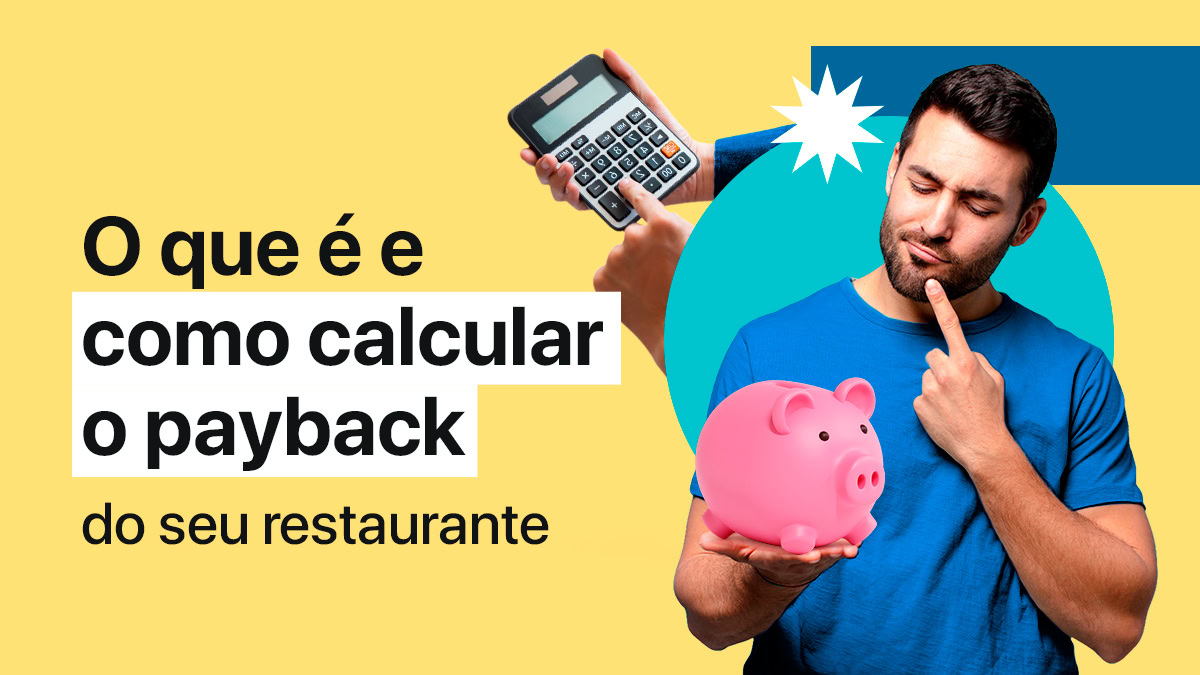
Want to know how long it will take to recover the amount you invested in your restaurant? Payback is the recommended indicator for that. It lets you understand the venture's financial return and helps with strategic decision-making.
In this article, learn what payback is and how to calculate it. Check it out!
What is payback?
Payback means “return”. It's an indicator that shows how long it takes to recover the initial investment of a business or project.
It can be used to evaluate both a new venture and a one-off investment — such as upgrading the space, purchasing equipment, implementing technology or opening a new location, for example.
Imagine, for example, that you're thinking about adopting totens de autoatendimento in your restaurant. Calculating the payback will help you understand in how many days, months or years you'll get your invested money back.
That makes it easier to understand whether the project is viable and at what point you'll actually start profiting from the improvements this technology enables.
Leia também: 7 food business ideas to invest in
What's the difference between payback and ROI?
Payback shouldn't be confused with Return on Investment, known as ROI. Although both are important financial indicators, their concepts are different.
Payback focuses on the time needed to recover the initial investment, without considering the value of money over time. It answers the question “how long until I get my money back?”
ROI, on the other hand, measures the percentage of profit generated relative to the initial investment, taking the value of money over time into account. It answers the question “how much profit did I make relative to what I invested?”
So the difference is in the approach. While payback focuses on the time needed to recover the initial investment, ROI calculates the efficiency of the investment.
What is payback for?
Payback analysis helps with decision-making, allowing for better financial management and strategic planning in your restaurant. It's useful for:
- Analyzing the viability of investments: understanding the payback period is important for deciding whether the venture is worth it or not.
- Comparing different investments: faced with several options, payback helps you choose the one that will bring the fastest return, optimizing resources and maximizing profit.
- Defining strategies: the indicator also makes it possible to list priorities, set goals and direct your efforts toward the initiatives that will bring the fastest return for your restaurant.
- Communicating results to stakeholders: payback lets you show investors, partners and managers the return on the investments made, strengthening the trust and credibility of your business.
Now that we've clarified the concept of payback and understood what it's for, let's learn how to do the calculation. But first we need to look at its relationship with cash flow. Read on!
The relationship between payback and cash flow
To calculate payback, you need to make a projection of your cash flow. Ou seja: estimar as entradas e saídas de dinheiro ao longo do tempo.
A positive cash flow, with more money coming in than going out, speeds up the return on the investment, while a negative cash flow, with more going out than coming in, delays the payback.
In the example we brought up earlier, for instance, you'd need to consider the gains and expenses related to implementing the self-service kiosks in your restaurant.
So it's important to have this cash flow projection in hand before calculating the payback. Below, check out the formula for simple payback and for discounted payback.
How do you calculate payback?
There are two types of payback that can be calculated: simple and discounted. The first doesn't consider the value of money over time, and the second uses interest rates and taxes as a reference to discount the amounts. Learn more below!
Simple payback calculation
Simple Payback is calculated by dividing the initial investment by the cash flow in the period considered. The formula is as follows:
Simple Payback = Initial Investment / Cash Flow in the period
For example, if the restaurant invested R$ 50,000 and the average monthly result of its cash flow is R$ 5,000:
Simple Payback = 50,000 / 5,000
Simple Payback = 10
That means the restaurant will take 10 months to recover the investment made.
Discounted payback calculation
The discounted payback adjusts for inflation, taking into account the loss of money's value over time. Although it is a bit more complex, this calculation gives a more realistic view of the payback.
Two concepts are used to calculate the discounted payback. The first is the Minimum Attractive Rate of Return (MARR), used as a parameter to determine the minimum desired profitability. In general, the Selic rate is used as a reference.
Besides that, you must calculate the Net Present Value (NPV), which calculates the current cash flow with future discounts, using the MARR. The formula is as follows:
NPV = Cash flow (CF) / (1 + MARR)¹
Once you have found the NPV, apply the discounted payback formula:
Discounted payback = Initial investment / NPV
Assuming the NPV is R$ 4,500, the calculation would be:
Discounted payback = 50,000 / 4,500
Discounted payback = 11.11
In other words: the restaurant will take a little over 11 months to recover the investment.
How long will it take to get a return on the investment in my restaurant?
This is the question every restaurant owner is eager to answer. Unfortunately, there is no single answer, since the payback period varies according to several factors:
- Investment amount: Larger investments will naturally have a longer payback.
- Restaurant cash flow: A restaurant with positive cash flow will get a faster return on the investment.
- Prices and costs: Price increases or cost reductions can speed up the payback.
- Marketing strategy: A successful marketing strategy can generate more sales and, consequently, a faster payback.
That is why managing your restaurant well is essential to getting a faster return. Having detailed financial planning, cutting costs, drawing up strategies to increase profitability and closely monitoring cash flow are some indispensable measures.
To do that, having a restaurant platform like EPOC can make all the difference! Our POS, ERP, Analytics and self-service solutions, among others, help hundreds of restaurants reach these goals.
If you want to know how we can help your business, Talk to our consultants.