
CAC: What It Is and How to Calculate It in Your Restaurant
Do you know how much you need to invest to win a new customer? Are your marketing efforts delivering good results? Or could you just be wasting money?
To answer these questions, you need to calculate the CAC (Customer Acquisition Cost). Essa é uma métrica que ajuda a analisar se as suas estratégias estão no caminho certo.
To understand what CAC is, learn how to calculate it and find out what to do to improve this indicator, keep reading this article!
What is CAC – Customer Acquisition Cost?
Every business needs to invest to win new customers, including restaurants and bars.
After all, it is not enough to open your doors and wait for customers to discover your establishment and keep coming back. That may work for a while, but if you do not invest in marketing, your business will most likely stagnate.
On the other hand, there is no point in running plenty of promotional campaigns to attract new customers if you do not measure the return. That can throw your finances out of balance and end up not being worth it.
That is why knowing your CAC (Customer Acquisition Cost) is essential. This metric represents the average investment needed to win a new customer.
The calculation covers all expenses related to marketing, advertising, promotions and other initiatives aimed at attracting customers. For example, if you spent R$ 5,000 on an advertising campaign and attracted 250 new customers, the CAC will be R$ 20 per customer.
This number helps you understand how much you are spending to bring new consumers to your restaurant, calculate the return on the investments made and measure the efficiency of your acquisition strategies. Portanto, serve de guia para você tomar decisões estratégicas.
Now that you know what CAC is, see how to calculate it below!
How to calculate CAC for restaurants?
A fórmula do CAC is as follows:
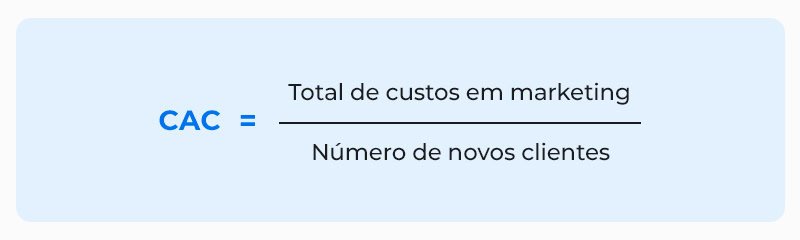
To calculate CAC for restaurants, you need to:
- Define the analysis period: Choose a specific time frame, such as a month or a quarter. This helps you focus on periods with specific campaigns or seasonal changes.
- Calculate total marketing expenses: Include all spending on advertising campaigns, promotions, sales commissions, digital marketing tools and even indirect costs related to promotional events.
- Determine the number of new customers: Use management systems such as a CRM or PDV to identify how many unique customers were acquired in the period.
Then just apply the formula. For example, let's say that in one quarter your restaurant invested R$ 12,000 in digital marketing, social media ads, discount promotions and local events. During that period, you managed to attract 600 new customers. The CAC calculation would be:
CAC = Total Marketing Expenses / Total Number of New Customers
CAC = R$ 12,000 / 600
CAC = R$ 20 per customer
This value can be compared to the average ticket of your restaurant to assess the financial viability of your acquisition strategies.
If you invest R$ 20 to win a new customer but they spend an average of R$ 15 per visit, it means your investment is too high for your audience's spending pattern. But be careful: this is a very simple analysis that considers a single visit and does not include other costs.
O ideal is to compare CAC to other indicators, such as LTV (Customer Lifetime Value). This metric shows the total value a customer generates over the entire period they visit your restaurant, that is: across recurring visits.
A restaurant's LTV can be calculated by multiplying the average ticket (R$ 50) by the purchase frequency (4x per month) and the retention period (24 months). The formula is as follows:
LTV=(Average Ticket x Purchase Frequency x Retention Period)
For the business to be sustainable, the LTV must be significantly higher than the CAC. For example, if your customers' average LTV is R$ 150 and the CAC is R$ 20, the ratio of 7.5 times indicates that your strategies are healthy.
Do you see now why building customer loyalty is so important? The more often they come back, the better the return on the investment you made to win them over.
Why is it important to analyze CAC?
Calculating your restaurant's CAC is essential to assess the efficiency of your marketing campaigns, support your decisions, plan your finances efficiently and ensure a good return on investment.
an high CAC may indicate that your acquisition strategies are not working efficiently. This can happen because of poorly targeted campaigns, excessive advertising costs or low customer retention.
All of this affects profitability, reduces your ability to invest in other areas that are important for growth and makes your restaurant less competitive in the market.
On the other hand, a low CAC reflects efficient marketing strategies and alignment with your target audience. The main advantages include a higher profit margin,
financial flexibility to invest in other areas and long-term business sustainability.
If you calculated your restaurant's CAC and found it to be high, check out the tips below to help reduce your Customer Acquisition Cost!
What can you do to reduce CAC?
To reduce your restaurant's CAC, you need to optimize your marketing efforts so they deliver better results with lower investment.
So the first step is to put together a solid marketing plan, understanding your audience profile and which strategies work best: types of promotions, social media ads, events and so on.
Using a restaurant system that collects demographic and consumption data from your customers is an excellent way to obtain valuable information to better target your campaigns. Isso permite atingir exatamente seu público alvo e atrair novos clientes para o seu restaurante.
Some strategies you can test to reduce your CAC are:
- Social media content: Take advantage of the potential of social media to increase the reach of your marketing campaigns without having to make large investments.
- Campaigns with local influencers: Invite micro-influencers from your area to promote your restaurant. They have an engaged audience and can help attract customers more effectively.
- Targeted promotions: Offer exclusive discounts to birthday customers or to those placing their first delivery order, for example. This kind of action tends to be quite effective at attracting new consumers.
- Segmented ads: Set up social media ad targeting for specific audiences based on location, age and food preferences. Test different audience segments and try out several types of ads to find out which perform best before increasing your investment.
- Groups and referrals: Create promotions for larger groups or offer discounts to those who bring a friend. This way you encourage your loyal customers to bring in new ones.
And do not forget to analyze your campaign results and implement continuous improvements, always aiming for better performance. That way you will be able to refine your actions, cut costs and win more customers.
Finally, invest in loyalty as well. As we have seen, this is essential to get the most return on your marketing investment. Offer a great customer experience, provide outstanding service and create a Loyalty program to keep your customers coming back.
Count on EPOC to optimize your results
Using a restaurant system that is modern and reliable is very important not only for greater efficiency and great service, but also for collecting data, tracking results and building more effective strategies.
A EPOC is a complete platform that can help you reduce your CAC and reach your business goals.
It offers features to collect customer information from both individual tabs and tables. This gives you demographic data and consumption preferences to better target your marketing strategies and promotions.
Our Dashboard Analytics also makes it easier to view and analyze data, providing insights so management can make better decisions and act proactively to optimize marketing and sales results.
How about discovering these and other EPOC features? Fale com nossos consultores, tell us about your challenges and find out how we can help your restaurant grow!