What does POS mean? Understand the benefits

You've very likely seen this acronym in plenty of places, but maybe you didn't know exactly What POS means – and you were too embarrassed to ask.
You can set that embarrassment aside, because we put this post together to explain exactly what a POS is, why it matters for bars and restaurants, and to share tips on how to choose a POS for your business. Check it out!
What POS means?
POS is an acronym for POS, which in turn is known in Brazil by the acronym PDV (Ponto De Venda).
More important than memorizing what those three little letters stand for is understanding that the POS is the place where customers pay for products/services and where the business records sales and carries out the internal processes related to those sales.
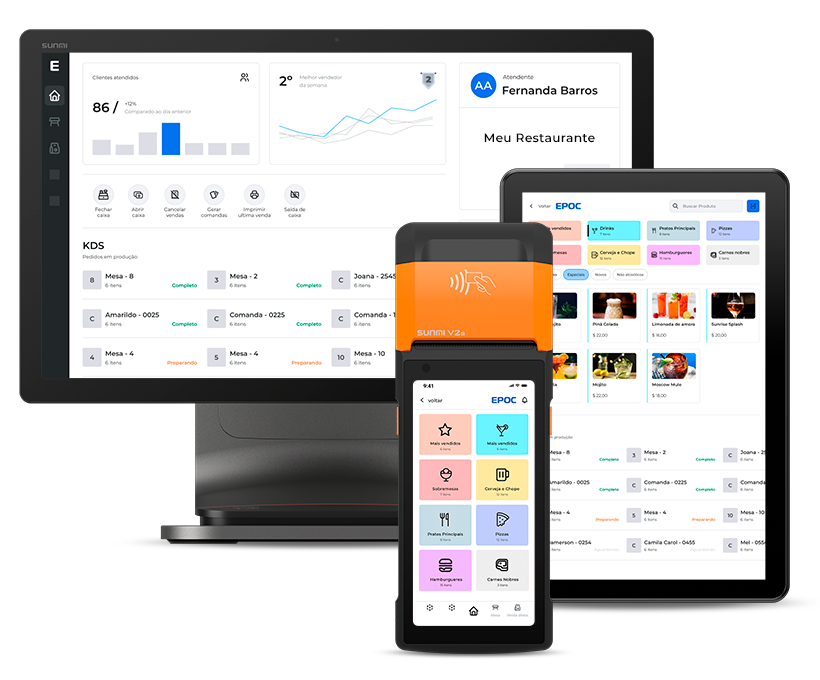
A POS usually has several pieces of equipment, such as computers, cash registers, invoice printers, smart card machines e even smartphones that can replace all of these, among others. These devices help carry out the sale and payment process between the bar/restaurant and its customers.
Beyond the physical equipment, a POS also needs software – that is, a POS system – that can record sales, issue invoices (internal and for customers), update inventory, among other functions.
But now that you understand what a POS is, why should you consider investing in point-of-sale equipment and software?
Because a POS can help you profit more and work less – and let's be honest, that's every entrepreneur's dream. Learn more about how a quality POS can help your business.
Leia também: Cash register software: what it is and what its benefits are

What are the benefits of a POS?
rely on an sistema PDV para restaurante that's up to date brings plenty of advantages. Both the business and its customers benefit from this kind of solution: the business gains more speed and efficiency in its operation and consumers get faster, easier service.
Take a look at three of the main benefits of a POS management system so it covers everything you need.
1 – Optimized operation
This is a benefit that connects to all the others you'll see below. With a POS solution you can automate, optimize and even review and drop tasks and processes to achieve more efficiency, speed and savings.
By combining a POS tool with a management system, you can automate a range of activities: recording orders, processing payments, inventory management, issuing invoices, among others.
This is where that idea of earning more by working less comes in: automation brings speed to the operation, which lets you serve more customers in less time and with less effort, and avoid wasting raw ingredients.
Learn more: Mobile POS: how it works and what the advantages are
2 – Customer loyalty
One result of a more efficient operation is that customers tend to come back to your business more often.
The math is simple: good service that always brings the right order, and fast + convenience at payment time without having to wait in long lines, and they can even do it straight from their smartphone = you become the customer's favorite bar/restaurant.
3 – Financial security
With an operations and POS management system, your business reaches a new level of financial security.
These features give you precise, real-time control over spending (on inventory, for example), revenue (through sales) and profits, as well as the menu items that sell the most – which, for example, can be given more prominence.
On top of that, using a tool prevents human errors, which can lead to discrepancies and oversights in financial control.
With a POS system, this kind of situation doesn't happen, because the tool handles the processes and activities automatically – and better still, you don't have to waste time updating a bunch of spreadsheets.
How to choose a POS?
Now that you understand what a POS is and know the benefits it brings, it's time to learn how to choose the best point-of-sale system for your business. But one important point is worth stressing: there's no magic formula here for knowing which tool is ideal — first, you need to define what you need.
Leia também: How to choose the best restaurant system?
For example, if your business is large, with a big number of checkout stations, or has an inventory with many ingredients, it's important to choose a POS that integrates all those parts; but if your bar/restaurant has a lot of self-service kiosks, prioritize a system that's compatible with that tool.
But of course there are some tips and best practices to help you find the POS of your dreams. Check out examples of POS systems with positive traits below:
- Prioritize systems that run in the cloud, that is, online and in real time. That way you minimize infrastructure costs and gain more flexibility in your operation;
- Choose a POS system that integrates with a management system for business (or, better yet, one that already includes this tool in a single solution). That way your business maximizes the benefits and automates and integrates every area, such as the checkout, inventory, kitchen, front desk, among others;
- Pay attention to support! After all, even the best software can run into problems, or the best employee can make mistakes or have questions, and that's when you'll realize how good technical support can save your life – or complicate it for good. The tip is to hire a POS system that offers human, fast support that's available most of the year.
See how easy it is to understand What POS means and, better still, how a POS system can help you get more efficiency, speed and profit in your operation?
Now Talk to one of our specialists and find out how EPOC POS can help your restaurant grow! Fill out the form below and we'll get in touch.