Japanese All-You-Can-Eat: 5 Tips to Profit
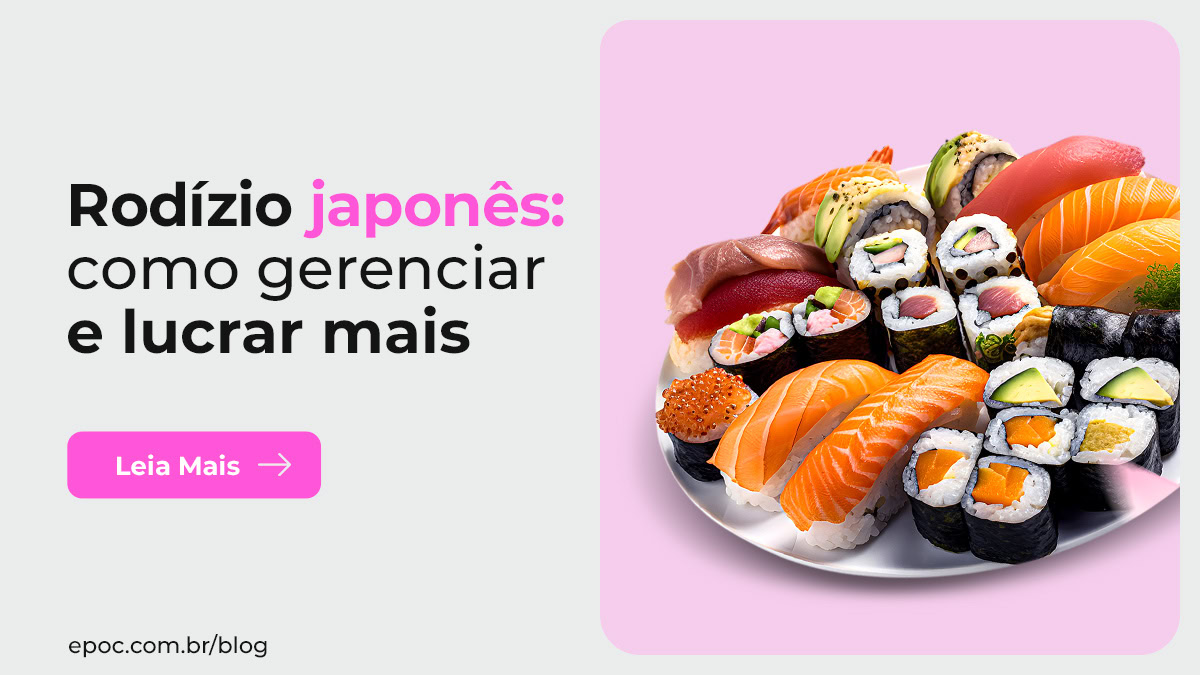
Japanese all-you-can-eat offers a wide variety of sushi for a fixed price, which is why it's one of the favorite restaurant types among Japanese food lovers. To attract this audience and keep them coming back, you need effective management that balances costs, quality and experience.
In this article, check out tips for managing a Japanese all-you-can-eat well and increasing your business's profitability. Follow along!
How does Japanese all-you-can-eat work?
Japanese all-you-can-eat is a service model in which customers pay a fixed price and can eat as much as they like from a variety of sushi and other dishes of Japanese cuisine.
Unlike à la carte service (in which the customer picks individual dishes) and buffet (where you serve yourself at the counter), at a rodízio the dishes are made on the spot, according to demand, and served to the customer right at the table.
This format lets customers try different types of dishes, from sushi and sashimi to hot dishes like tempura, yakisoba and other specialties.
So Japanese all-you-can-eat stands out for its more affordable price, its variety of options and the complete dining experience it offers.
What is served at an all-you-can-eat sushi restaurant?
The Japanese all-you-can-eat menu includes a variety of starters, sushi, sashimi and hot dishes.
To please every taste, from newcomers to Japanese cuisine to the most demanding palates, you need to offer plenty of options, from the most classic sushi pieces to more elaborate preparations.
Building an attractive menu is essential to stand out in this market, since competition is high and consumers are demanding and always on the lookout for something new.
The most common options on an all-you-can-eat sushi menu include:
- Starters: sunomono, buttered shimeji, missoshiru, ceviche, gyoza, edamame, harumaki
- Sushi: varieties of uramaki, hossomaki, nigiri, joe, hot rolls
- Sashimi: cuts of salmon, tuna and white fish
- Temaki: varieties such as Philadelphia salmon, skin, tuna, kani kama.
- Hot dishes: tempura, yakisoba, ramen.
An all-you-can-eat menu can vary according to the restaurant's concept, but the main goal is always to offer a complete meal in which customers can eat as much as they like of different types of dishes.
Leia também: Sushi combos: learn how to build them and boost your profits
How much does Japanese all-you-can-eat cost?
The price charged at a Japanese all-you-can-eat can vary quite a bit, depending on the restaurant's location, the quality of the ingredients used and the type of audience the business wants to attract.
Prices normally range from R$ 80 to R$ 150 per person.
To succeed with this business model, you need proper pricing, taking into account not only the costs involved in production and a good profit margin, but also the prices your competitors charge and the value customers perceive.
Japanese restaurants that offer a more sophisticated dining experience — with high-quality ingredients, exclusive recipes, a well-decorated space and excellent service — can charge more and achieve high profitability.
But it's also possible to get excellent results with a simpler concept, with traditional dishes and a more affordable price, attracting customers who are looking for variety and good value for money.
5 tips for managing a Japanese restaurant well
To ensure the success of a Japanese all-you-can-eat, you need efficient management that guarantees product quality, a good customer experience and high profitability. Below, check out the main points that deserve attention in this business model.
1 – Controle de estoque
At a Japanese all-you-can-eat you have to guarantee that fresh ingredients are always available, which is why controle de estoque is one of the operation's critical processes.
Tracking products coming in and going out precisely, managing purchasing well and having an organized space for proper storage of supplies is essential to maintain quality and offer the best products to customers.
2 – Reducing losses and waste
The losses e waste can wipe out a Japanese restaurant's profitability. After all, when you throw ingredients and dishes away, you're losing all the money invested to buy those supplies, with no financial return at all.
So you need to use some strategies to reduce losses and waste.
Besides efficient inventory control, it's also recommended to have Recipe cards and standardized recipes for each dish, defining the exact amounts of each ingredient and the portion sizes.
Another point to watch is making full use of ingredients, especially the fish. In that sense, having a skilled, well-trained kitchen team is very important to cut down on waste.
3 – Price setting
A pricing done right is one of the biggest challenges in managing any restaurant, and all-you-can-eat sushi is no different.
To determine the ideal price and have a good profit margin, you should consider all the costs involved in production, from ingredients to labor and keeping the operation running. Calculating and tracking the Cost of Goods Sold (COGS) is the best strategy for that.
Besides that, it's also important to consider your competitors' prices and the value customers perceive, along with other aspects that can affect prices, such as swings in demand and the product life cycle.
4 – Product quality
Keeping a high standard of quality is what builds customer loyalty and maintains your restaurant's reputation in the market.
For that, you need to choose good suppliers who are reliable and consistently deliver quality products. When the goods arrive, it's important to check that they are fresh and meet the restaurant's standards.
In production, the kitchen team must be skilled and trained to handle and prepare the dishes, following good food safety practices and preserving the quality and flavor of each piece.
5 – Customer experience
Providing a good more contemplative is the secret to building customer loyalty, earning recommendations and keeping the house always full. That's why you need not only to serve good meals, but also to have a pleasant space and deliver excellent service.
Your Japanese restaurant's décor can be a way to set yourself apart from the competition and attract more customers. Fast service, meanwhile, is essential — and that includes hospitality, organization and speed in taking orders and payments.
Count on EPOC to increase your sushi restaurant's profitability
To deliver fast service and manage your Japanese all-you-can-eat well, you need to have an efficient restaurant system like EPOC.
With it you get complete solutions: POS for fast service, ERP with inventory control and recipe cost cards, Analytics to track your results and map out growth strategies, among many others.
If you'd like to find out how we can help your business increase its profitability, talk to our specialists!