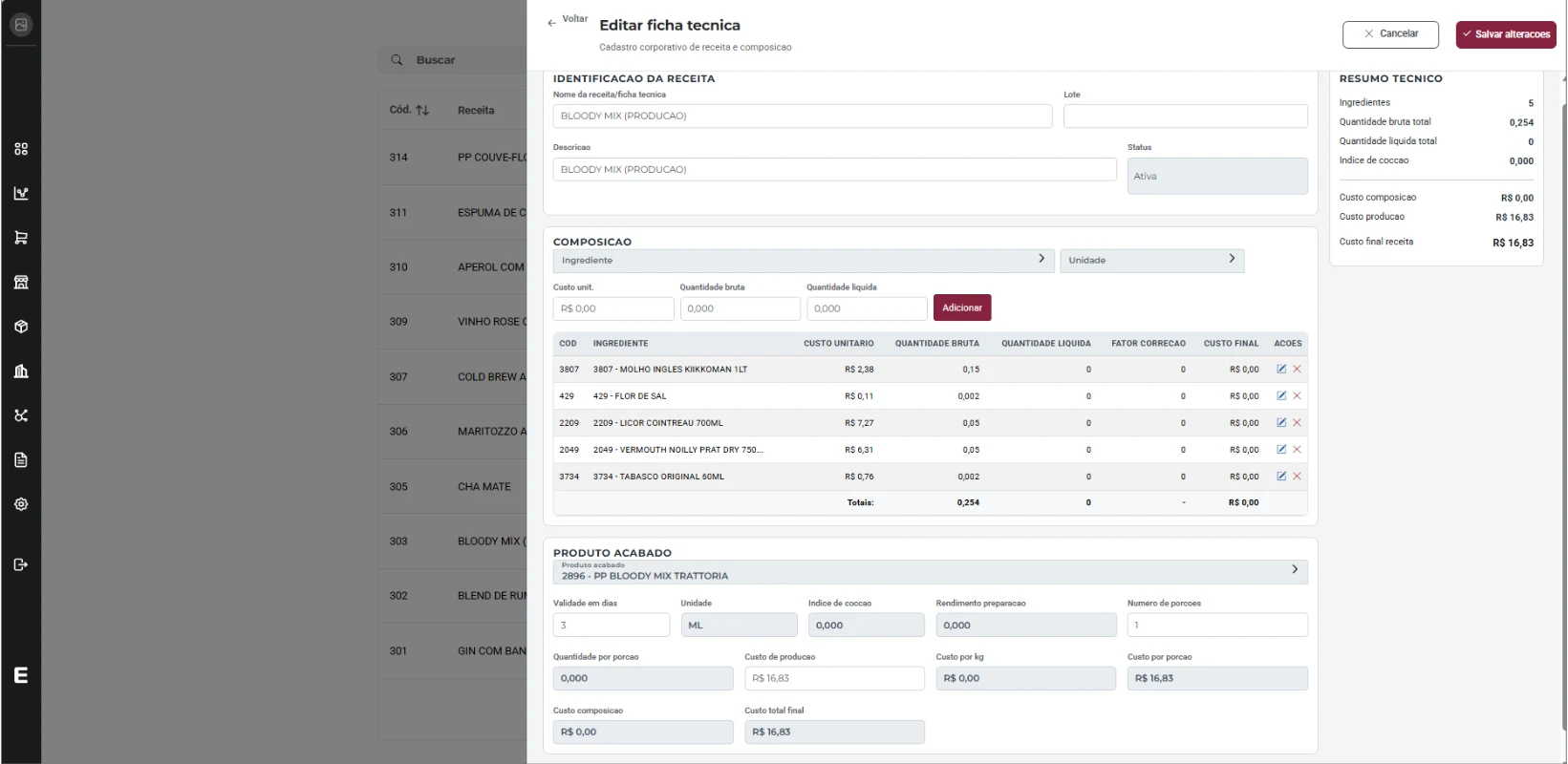
Recipe card with yield and waste
Recipe, yield, and cost per product — the basis for CMV and margin.
Platform · Management layer
Consumption is deducted with every sale — loss no longer waits for inventory.
In food service operations, inventory disappears in the details: an extra gram per dish, a poorly measured portion, an unrecorded loss. Without the recipe card tied to the sale, no one knows how much should have gone out — only how much is left, and late.
CMV becomes a guess, and margin along with it. Purchasing happens in a scramble, either short or over. And the gap between what the recipe predicted and what actually went out — where waste and shrinkage live — only shows up when inventory closes, by which point it's too late to act.
Layer 02
It's the management layer tied to the operation: the recipe card is defined centrally, the POS deducts consumption with every sale, and the result — CMV, shrinkage, turnover — flows up into the data.
Recipe, yield, and cost per product — the basis for CMV and margin.
Theoretical inventory moves with every dish sold, with no manual entry.
The physical count confirms the theoretical figure; the difference is the exception, not the only number available.
What to buy is based on actual consumption and minimum inventory, not on guesswork.
Shrinkage recorded and traceable, so it stops disappearing in the middle of operations.
Cost of goods sold broken down by item and by location, comparable across the chain.
Inventory remains useful as verification, but stops being the only way to know stock levels. Theoretical inventory runs on its own through the recipe card; physical inventory only validates it.
It does. Yield and loss are what make the cost realistic — and with it, CMV and per-dish margin stop being estimates.
It does, and that's where it matters most: production recipe cards with yield are what the patisserie page covers in detail.
Talk to a specialist
How many locations, what stack is already running, what needs to be integrated, and what the rollout would look like.