Types of Menu: 13 Models to Choose From
The menu is much more than a list of the dishes offered. It also reflects the concept and personality of the business, influences sales, and makes service easier.
That's why it's important to use the right format, taking into account your restaurant's concept and goals.
In this article, understand why this decision is so important and check out the different types of menu you can adopt, along with their advantages and disadvantages. Keep reading and make the best choice!
Why does the menu format matter?
The menu's main function is to present the dishes offered to customers, which is why it's extremely important and impacts different aspects of the business.
A beautiful, well-kept menu makes a good first impression and reinforces the brand. When it's strategically designed, it can help drive sales and even improve operational efficiency.
Below, learn more about the importance of choosing the ideal type of menu for your restaurant.
customer experience
The format and design determine how the customer handles or interacts with the menu itself. Flipping through a leather-bound menu is very different from navigating a self-service kiosk, for example.
So you need to consider your restaurant's concept and the type of experience you want to offer your customers when choosing the type of menu.
For a high-end à la carte restaurant with an intimate concept, having a self-service kiosk makes no sense at all. On the other hand, this option can be perfect for a burger joint.
In addition, a well-designed menu provides clear, objective descriptions of each dish, so customers have no doubts and order faster. This makes the process much simpler and the experience smoother and more pleasant.
Brand reinforcement
The menu is also a marketing tool. It reflects your restaurant's identity and personality. This is essential for creating an emotional bond with customers and reinforcing your brand.
So every detail matters. The format, images, colors, and typography should align with the establishment's concept.
A sustainable restaurant, for example, can use recycled paper or a digital menu. A fast-food burger joint, on the other hand, might go for tablets or self-service kiosks so customers have more autonomy and speed when ordering.
Sales strategy
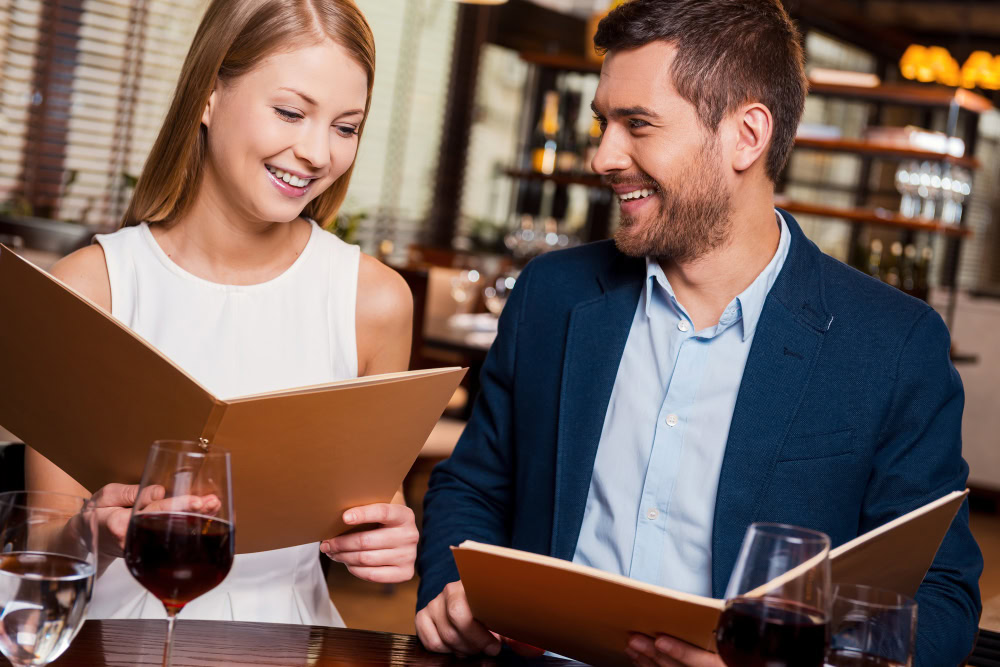
The menu also has a big impact on sales and can influence customers' buying decisions. Techniques for engenharia de cardápio help make the menu more strategic, highlighting the most profitable and popular items.
In this sense, the type of menu also makes all the difference. A digital menu is much more dynamic and easier to edit than the traditional paper one, which can be advantageous if you run promotions or introduce new items more frequently.
A menu board, for example, lets you include large, eye-catching, dynamic images, creating a visual impact that helps boost sales. The same goes for self-service kiosks.
operational efficiency
Finally, the type of menu you choose can also contribute to better operational efficiency.
The most modern options – like the QR Code digital menu, on a tablet or kiosk – are advantageous because they're integrated with the restaurant's system.
This makes it possible to automate different processes: managing orders in the KDS, recording sales in the POS, deducting inventory, and more.
Now that you understand the importance of choosing the ideal menu for your business, check out some format options you can adopt and learn the advantages and disadvantages of each.

13 types of menu for restaurants
There are many menu formats and models you can adopt in your restaurant. To make a good choice, you need to consider:
- Durability of the material
- Ease of reading and handling
- Costs involved in production and updating
- Organization of the information
- Design and finishes
- Fit with your establishment's concept
- Impacts on operations
With that in mind, check out some of the most widely used types of menu below and discover which one is best suited to your restaurant!
1 – Hardcover menu
This is the most traditional type of menu, with a cover made of durable material, such as leather or plastic, and printed pages inside. It's typically used in restaurants that value sophistication and elegance.
Since it's harder and more expensive to update, it's recommended for restaurants with fixed, long-lasting menus.
2 – Folded menu
The folded menu is compact and practical. It's usually the size of an A3 or A4 sheet, folded in two or three parts. There are also variations in fold styles, such as the window fold and the Z-fold, for example.
This type of menu lets you categorize and organize information clearly, while also being compact and easy to handle. That makes it ideal for restaurants that offer a wide variety of options, such as à la carte pizzerias.
However, it's usually not very durable. Even when using heavyweight paper with a laminated finish, it tends to wear out over time.

3 – Laminated menu
Laminated menus are very functional and durable. They're usually made on a single A4 or A3 sheet, front and back.
It's widely used in restaurants with high customer traffic or located by the beach or pool, since the plastic is resistant to liquids.
However, it has a simple look. For that reason, it may not be a good idea for more upscale restaurants. Another downside is that the material isn't easily recyclable.
4 – Spiral-bound menu
This model uses spirals to hold the pages together, which makes it easier to open and handle, offering convenience and flexibility. With a more informal look, it's a common option in cafés and bars.
Another big advantage is how easy it is to update, since you can add, remove, or swap just a few of the pages. Although it holds up well, especially if the inside pages are laminated or even plastic-coated, the spiral can wear out over time.
5 – Binder menu
The binder menu is a practical choice for restaurants that frequently change their offerings. It lets you add and remove pages easily, while also protecting the paper with plastic sleeves.
Despite its functionality, it isn't very elegant and can be quite heavy and hard to handle. On top of that, if it has too many pages, it can look confusing and make it harder for the customer to choose.
6 – Triangular menu
The triangular menu works like a table tent display. It's a great option if you have just a few items on the menu or want to highlight a promotion or encourage the purchase of a dessert, for example.
It grabs customers' attention and can help boost sales of a specific dish. In other words: it works as a sales strategy to increase your profitability.
7 – Clipboard menu
This type of menu is quite popular in bistros and trendy restaurants. The menu is printed on plain paper and clipped to a clipboard, creating a feel that's rustic and modern at the same time.
One downside is that the clipboard can be very bulky and hard to handle. The sheets can also wear out quickly, but replacing them is simple and cheap.
8 – Chalkboard
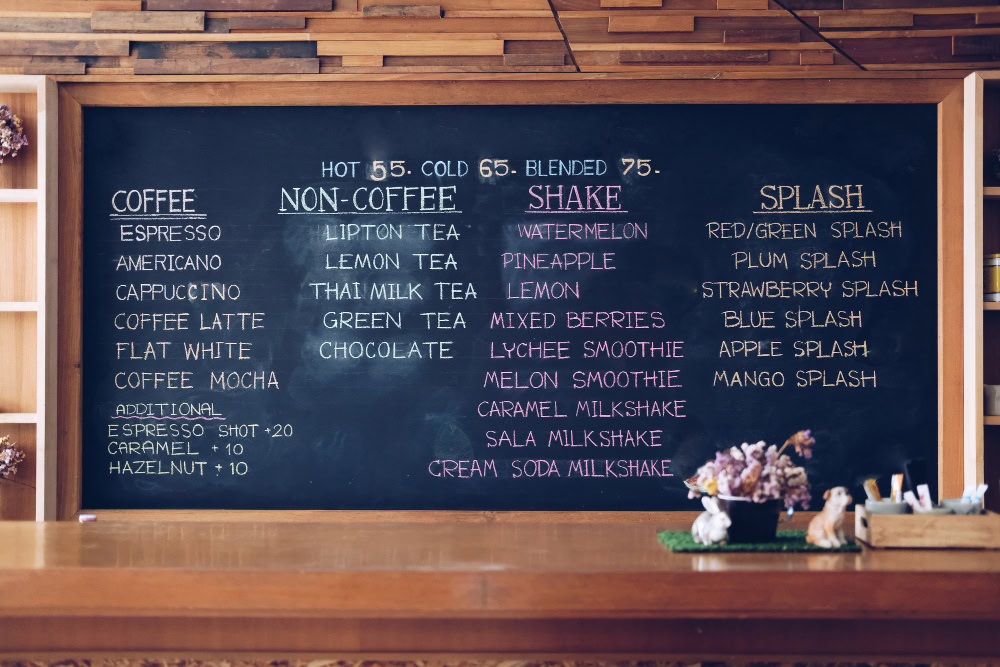
Laid-back restaurants and bars often use chalkboards to display their menus, especially for daily specials. The text is handwritten, giving it an artisanal feel.
They're great for creating a warm, casual atmosphere. They're also easy to update and customize daily. They can be used outdoors to grab attention and invite customers in.
The drawback is that it can be hard to read from a distance or in the dark. And it's also not recommended for extensive menus.
9 – Wall panel
The wall panel is widely used by fast-food chains, and they're usually located above the order counter.
They show the full menu, letting customers easily view the options as soon as they arrive at the venue. It's the perfect choice for very busy restaurants, since it speeds up the flow of service.
Its installation and updating can be a downside, since the cost is high.
10 – Menu board
A digital version of the wall panel, the menu board offers the same benefits, with the added advantage of displaying the menu and promotions dynamically and the flexibility to change the content in real time.
Attractive and modern, it lets you highlight images and include videos and animations. As a result, it has a strong visual impact that can encourage customers to spend more, raising your average ticket.
It's an option with high installation and maintenance costs, and it also depends on reliable technology to run without glitches.
11 – QR Code digital menu
O digital QR Code menu became popular during the pandemic. Customers scan the code with their smartphones and view the menu in digital format — which can range from a simple PDF file to an online menu that lets the customer order on their own.
This is a practical, modern solution, with a low initial investment that allows updates at no extra cost. It makes service faster and can be integrated with the restaurant's system, optimizing various processes.
However, some customers may have trouble accessing it, and a good internet connection is required.
12 – Digital tablet menu
O digital tablet menu is an interactive, modern, and appealing solution. The tablets can be installed at the counter or on the tables, letting customers browse the menu and place their order directly on the device.
Besides giving customers autonomy and speeding up service, the tablet menu can be updated in real time, making it easy to update menu items and set up featured highlights.
The initial cost to implement the system is higher than the investment in printed menus, but in the long run the return can pay off, since it tends to increase the average ticket of sales and reduce operating costs.
13 – Self-service kiosk
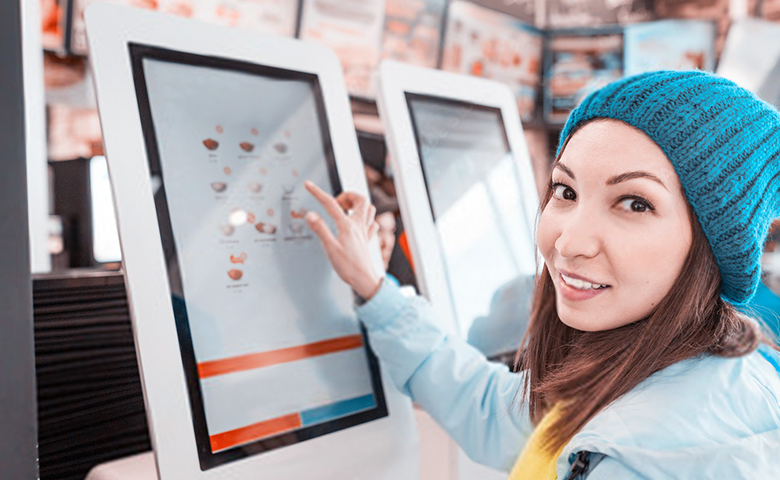
O Self-Service Kiosk lets customers place their order on their own, without relying on a waiter or attendant. It displays an interactive menu, with dynamic, appealing images, that the customer can browse to complete their purchase.
With it, you can easily make real-time updates, highlight promotions, suggest products based on the customer's order, and use other features that help increase sales and revenue.
The kiosk is also advantageous from an operational standpoint, since it lets you reduce staff, cutting costs. On top of that, it can be integrated with the inventory control system and the KDS, for example, bringing more efficiency end to end.
Although the initial investment is high, it's also one of the solutions with the best return.
Discover EPOC's solutions for your restaurant
Choosing the ideal type of menu for your restaurant is essential to giving your customers a good experience, reinforcing your brand, and performing well in sales.
But to succeed in your business, you need much more than a perfect menu. You have to provide good service and manage effectively. That's why having an efficient restaurant system is indispensable.
EPOC is a platform with complete solutions for your business: POS, ERP, KDS, Analytics, Payments, Digital Menu, Self-Service Kiosk, and much more!
Para saber como podemos ajudar seu restaurante a crescer, fale com nossos consultores!