ERP Management System: What It Is and Advantages
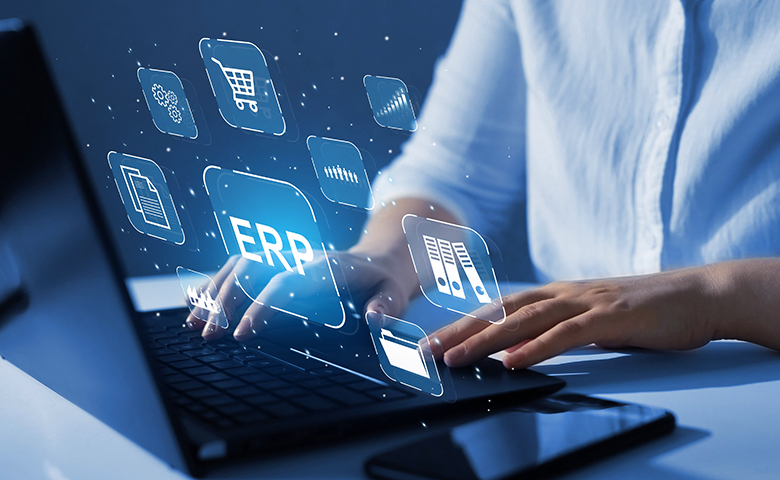
Have you ever felt that you don't have control of your bar or restaurant's operation? You can't keep track of sales, you don't know how inventory is doing, you have no visibility into results? That can be solved by adopting an ERP management system.
This technology centralizes information from the different areas of the business, making management easier and supporting decision-making. It also lets you automate processes and, in doing so, increase the efficiency of the operation.
So, do you want to find out how to get these benefits in your business? Read this article to understand what ERP is, what its features are and its advantages for restaurants and bars. Follow along!
What is ERP?
The acronym ERP stands for “Enterprise Resource Planning”.
O Management system ERP is software for managing a company's resources and processes. Divided into modules, it brings together on a single platform the data from the organization's different areas, making integration between them possible.
So, in the case of restaurants and bars, for example, the ERP system can include several modules geared toward managing the operation, such as:
- Administrative
- financial
- tax
- purchasing and inventory
- payments
- Sales (CRM)
- PDV
- Among others
That way, there's no need to use a specific system for each area. Instead of having one piece of software for financial management, another for the POS and another for inventory, you can have all of it integrated on a single platform.
As you can imagine, the advantages of this are many, and we'll talk about them later on.
How did ERP come about? Learn the history
It may seem innovative and recent, but the ERP concept started being developed more than 100 years ago. See the timeline below to understand how this management model evolved.
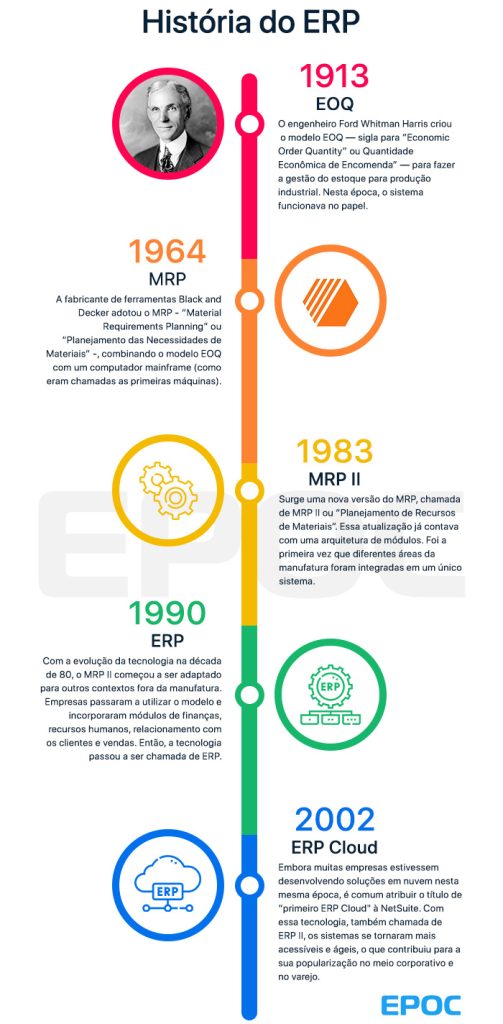
And of course, systems never stop evolving. Data analysis technologies, artificial intelligence and machine learning are already being applied in ERPs and expanding their benefits.
These advances make it possible to automate routine processes, forecast demand, analyze data in real time and improve strategic decision-making. And there's certainly much more still to come.
What is an ERP management system for?
It's no accident that the ERP system is used by companies of all sizes and sectors. It's a robust tool that offers a comprehensive view of every aspect of the business.
Because it's complete software, it lets you manage processes in an integrated way, eliminating the need to use several isolated systems that don't talk to each other. So one of its main functions is integration between areas and process automation.
A practical example: if a sale is made, the system automatically deducts it from inventory. If the product reaches the minimum inventory level, an alert is sent to the purchasing department.
That way, the flow of information between the company's different areas is much more secure and efficient. On top of that, you can also track data in real time.
Because ERP systems are organized into modules, they can be customized according to the needs of the business. That's why there are solutions aimed at specific market segments. EPOC, for example, was developed especially for bars and restaurants.
Learn more: Bar and restaurant management systems: see the advantages
Main features of an ERP
Using this solution, you can manage practically all of your company's processes and information, such as:
- Finance
- Accounting
- Purchasing and receiving
- inventory
- Customer registration
- Sales (CRM)
- payment methods
- Human resources
- Equipment
- Audits
- Performance analysis
Understand a bit more about how the ERP system works below.
How does the ERP system work?
As we've seen, ERP systems use a software architecture that allows different modules share information and communicate with each other. In other words: the database is centralized and can be accessed by different users.
To ensure the security of information and of the operation, you can configure access permissions for each area of the company and each employee. That way, the manager can control and audit any action performed in the system.
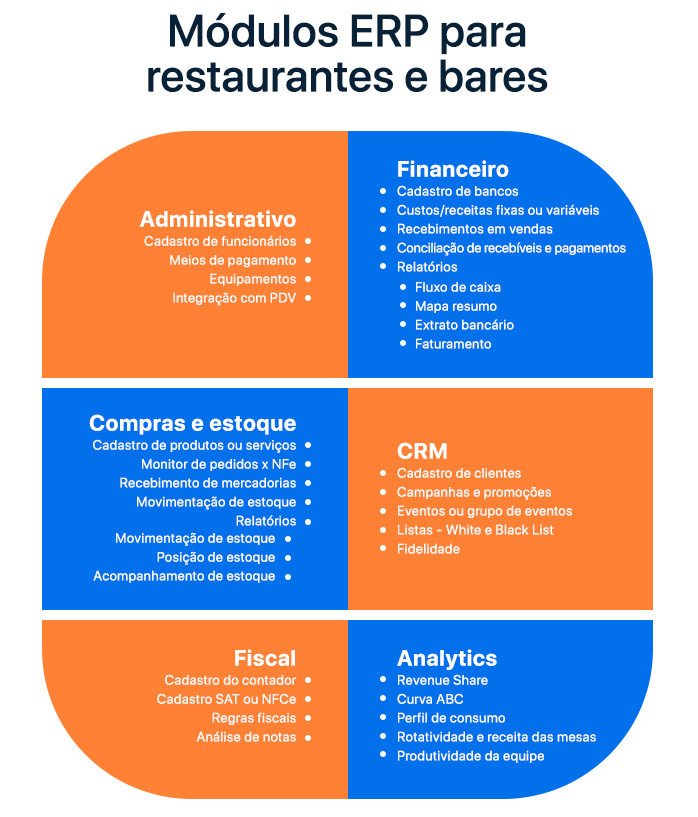
Each of the ERP modules includes a series of features specific to that area. So a “Finance” module, for example, may have features for cash flow management, billing, revenue and fixed and variable costs, among others.
See below an example of modules that can make up an ERP for restaurants and bars and their main features:
What's the difference between ERP, POS and CRM?
There are countless management systems for companies. Each one has a different purpose and features. We've already seen what ERP is, but a common question comes up: what's the difference between ERP, POS and CRM?
Often, these systems are integrated into the ERP, but it's important to tell them apart to understand what role they play in an operation. See below a brief definition of POS and CRM:
PDV
It's the acronym for “Point of Sale” (POS). It's where the customer makes the payment and the company records the sale.
Because of that, it's an essential solution for any operation that serves the public, such as retail and food service companies.
The POS is made up of equipment (cash registers, computers, printers, payment machines, etc.) and also software, where all sales and charges are managed.
Leia também: POS: what it is, its features and advantages
CRM
It's the acronym for “Customer Relationship Management”. This software's job is exactly what the name suggests: tracking contacts with customers and sales.
CRM is widely used to manage more complex, longer sales processes that require several contacts at different times. It's also used by retail companies and other sectors to record customer history.
In bars and restaurants, for example, you can register personal data (name, phone, address, etc.) and record which dates the customer visited the business, what they ordered, how much they spent on average, reservations and other notes.
That's why it's a very effective tool for tracking customers' consumption patterns and creating retention and loyalty strategies.
What are the advantages of ERP?
Using an ERP management system in your company has several benefits. See below what the main ones are.
Integration between areas
One of the main benefits of ERP is integration between areas. Because all information and processes are concentrated in one place, communication is much simpler and faster.
Unified control
The manager gets a complete view of the entire operation using a single system. There's no need to access several different pieces of software to build reports and analyses — let alone keep countless Excel spreadsheets.
Process automation
The system also makes it possible to automate repetitive processes, such as deducting from inventory when a product is sold. That way, the operation gains in productivity.
Optimized information flow
With an ERP, information flows better between areas. There's no need to duplicate data or export spreadsheets to enter them into another system, for example. Besides being more secure, this reduces errors in information and makes an integrated analysis of results possible
Smart management
And speaking of analysis, with an ERP the manager can make smarter decisions, based on data. From dashboards with a comprehensive view of the operation, they can control the operation, track how the business is doing and map out strategies for improvement.
Cost reduction
All the benefits mentioned above lead to cost reduction. After all, the system provides the conditions for the operation to be more efficient, the team to be more productive and management to be able to identify bottlenecks quickly, making the necessary adjustments.
What's the best ERP management system for a restaurant or bar?
ERP is adaptable to different types of business. The modules can be developed according to the needs of each one — which is exactly why it's so popular.
A system for restaurants and bars should include features that let you control the operation from customer service through to data analysis. EPOC was developed especially for this purpose. It includes:
- Administrative back office
- Gestão financeira
- Controle de estoque
- Purchasing management
- Tax management and SPED
- CRM
- Analytics
On top of that, there are other advantages that make EPOC the best ERP for bars and restaurants.
It integrates solutions for the efficient operation of restaurants and bars, such as a POS system, digital menu, self-service, KDS system, Delivery Hub, payment methods and much more.
With EPOC, the manager has all the establishment's information available for tracking and analysis. In the case of chains or groups, data from all stores can be integrated on a single screen. You can even monitor the operation in real time, from anywhere.
The data analysis module has a dashboard with visual reports for managing the business. Com ele, o gestor pode visualizar facilmente:
- Revenue Share of the entire operation
- Detailed products and services with ABC Curve
- Customer behavior and consumption profile, with demographic report, dwell time and average ticket
- Table turnover and revenue
- Sales volume and revenue
- Staff performance and comparison
Find out how EPOC can revolutionize your operation
ERP is an essential tool for any restaurant or bar that wants an efficient, profitable operation. With this solution, the manager has full control of the business, can run analyses easily and make the right decisions to boost results.
If you want all these benefits in your business, count on EPOC! Request contact from our consultants and find out how to take your bar or restaurant's management to the next level.

Frequently Asked Questions
What is an ERP system?
It's software for managing a company's resources and processes. ERP is divided into modules, bringing together on a single platform the data from the organization's different areas, making integration between them possible.What is an ERP system for?
Because it's complete software, ERP lets you manage processes in an integrated way, eliminating the need to use several isolated systems that don't talk to each other. The system can include modules such as: Finance, Accounting, Purchasing and receivingInventory, Sales (CRM) and Human resources.
How does the ERP system work?
ERP systems use a software architecture that allows different modules to share information and communicate with each other. Each of the ERP modules includes a series of features specific to that area. The database is centralized and can be used by different users, with distinct access permissions.How can an ERP be implemented in a restaurant?
An ERP can be implemented in a restaurant or bar to make the operation more efficient. The system lets you track and manage processes such as sales, inventory control, purchasing, tax and financial management, customer relationships, among others. There are specialized vendors, such as EPOC, that offer solutions in the cloud and also on local servers, ensuring complete security.What are the benefits of an ERP system for a restaurant or bar?
An ERP system has several benefits for restaurants and bars, among them: more efficiency in the operation, greater team productivity, control and tracking of the entire business on a single platform, more intuitive analysis of results and more strategic, smarter management. With that comes cost reduction and increased profitability.How do you combine CRM and ERP in a restaurant?
There are ERP options for restaurants such as EPOC that already include a CRM module. With it you can manage Customer registration, Campaigns and promotions, Events or event groups, Lists – White and Black List, Loyalty program and Mailing.If the restaurant already uses an ERP or CRM solution, you need to contact the vendors' support teams and check whether integration between them is possible.