
RevPASH: What It Is and How to Calculate

RevPASH (Revenue per Available Seat Hour) is a metric that shows the revenue generated per available seat per hour in a restaurant.
By measuring and tracking this key indicator, you can map out strategies to make better use of your venue's space, gain operational efficiency and increase profits.
In this article, we'll look at what RevPASH is and how to calculate it. Follow along!
What is RevPASH?
The acronym RevPASH stands for “Revenue per Available Seat Hour.”
As the name suggests, this metric relates the revenue earned (sales) to service capacity (seats) and time (hours). So it measures the revenue generated per seat in each hour of operation.
Unlike other indicators, such as the average ticket, which shows the average spend per customer, RevPASH focuses on occupancy and length of stay, helping to assess operational efficiency.
This approach is very useful for high-turnover restaurants, such as fast food, self-service or all-you-can-eat. It's also recommended for businesses that are already established in the market and have reached the stage of optimizing results.
Next, we'll look at the main benefits of using RevPASH in your restaurant. Check it out!
Why use this metric?
Tracking your restaurant's KPIs (Key Performance Indicators) is essential for effective management.
From data analysis, you can make well-founded decisions, map out improvement strategies and gain a competitive edge in the market, getting ahead of the competition.
Among the many indicators that help assess performance in terms of revenue generated and profits earned, RevPASH lets you connect sales results with operational efficiency.
If you only consider the average ticket, for example, you may be under the illusion that you're getting good results, when in fact you're not making the most of your venue's capacity.
Let's suppose you serve 20 customers during dinner and reach an average ticket of R$ 70. That may even look like a good result, but if you take into account that you have 100 seats available, it means each seat generated only R$ 14 in revenue.
And even if you're at 100% occupancy with a satisfactory average ticket, the length of stay may be high. How many customers are left waiting or gave up? How much more could you earn with more efficient service?
Since RevPASH also takes the period/hour into account, it lets you understand whether your table turnover is adequate or whether you need to speed up service.
From these analyses, you can map out more effective strategies to increase your profitability without having to raise prices or the number of available seats. In addition, there are several other benefits to using RevPASH:
1 – Adjust your operation
By understanding the revenue generated per seat in each period, you can plan better and adjust your operation for greater efficiency and profitability. For example: buying the right amount of supplies and hiring enough staff.
2 – Identify idle capacity
RevPASH lets you see the slowest days and times, when your restaurant has idle capacity. Knowing this, you can create strategies to attract more customers at those moments, such as promotions or special menus.
3 – Optimize the use of space
By analyzing how efficiently seats are occupied, you can also optimize the table layout or even redesign the restaurant's floor plan. That way, you can increase turnover and serve more customers per hour.
4 – Improve customer flow
Understanding how customers use the space can help you adjust internal processes, reducing seat occupancy time without compromising the customer experience.
In that sense, training your staff to deliver excellent service and using technology as an ally for greater speed is very important.
5 – Create promotions
RevPASH can guide the creation of pricing strategies and offers to maximize revenue at different times of operation.
That way, you can adapt your menu and create more targeted promotions, achieving better results.
6 – Assess overall performance
This metric helps you understand whether revenue is aligned with the restaurant's capacity and whether the space is being used efficiently. This insight is essential to your business's success.
7 – Prepare for expansion
By identifying high-occupancy hours and consistent demand, the restaurant can consider expanding its space or opening new locations. With the help of this indicator, it will be possible to calculate the return on investment more accurately.
How to calculate your restaurant's RevPASH
Now that you understand what RevPASH is and the advantages of using this indicator at your restaurant, let's see how to do the calculation.
The RevPASH formula is as follows:
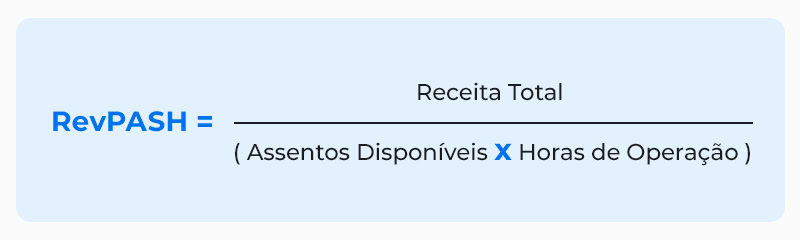
- Total revenue: The sum of all sales made during the period analyzed.
- Available seats: The number of customer seats in the restaurant.
- Hours of operation: Total number of hours the restaurant was open during the period considered.
Imagine your restaurant generated R$ 10,000 in sales in one day. It has 50 seats and was open for 10 hours. we have:
RevPASH = Total Revenue / (Available seats x Hours of operation)RevPASH = 10,000 / 50 x 10
RevPASH = 10,000 / 500
RevPASH = 20
So the RevPASH in this example is R$ 20, meaning each seat generated an average of R$ 20 per hour.
This calculation can be done for different periods (hour, day, week, month). It's recommended to evaluate peak hours, such as lunch and dinner, and slower periods, to identify patterns and growth opportunities.
Compare the RevPASH calculated for peak hours and slower hours to identify trends. For example, if the value is lower during the afternoon, that may indicate an opportunity to create promotions or adjust the menu.
There is no ideal value for RevPASH, since it depends on the restaurant's model, capacity and location, and other aspects. What's more, it's dynamic and can vary quite a bit over time.
Therefore, the most important thing is to track it regularly and analyze how it evolves, measuring the impact of the changes implemented and adjusting your strategies as needed.

What to do to increase your RevPASH
If you've calculated your RevPASH and found the result unsatisfactory, here's what you can do to improve your results.
Basically, you need to increase your occupancy rate, table turnover, and revenue. So take a close look at these aspects to identify the factor that may be hurting your restaurant's performance.
1 – Occupancy rate
The occupancy rate shows how well your restaurant's space is being used. If it's very low, that means you're having a lot of idle periods, with few tables occupied.
To solve this, you need to attract more customers to your restaurant during that period, adapting your offerings to your audience profile and consumption habits.
Investing in marketing, creating promotions, hosting events, and having a loyalty program are some ways to drive traffic to your business and increase your occupancy rate.
Learn more: How to attract customers to restaurants: 13 tips
2 – Table turnover
If your restaurant has a high flow of customers, the problem may be a long dwell time. This is usually a consequence of low operational efficiency.
to reduce dwell time and, consequently, increase table turnover, you need faster service: seating customers quickly, entering orders swiftly, keeping high productivity in the kitchen, taking payments efficiently, and so on.
These points can be improved by reviewing processes, implementing technology, and training your team.
3 – Revenue
The two previous points already help increase revenue, but you can map out sales strategies to get even better results and reach maximum profitability in your business.
To do that, your focus should be on strategies to increase your average ticket. Treinar sua equipe para vendas, fazer upsell e cross sell, implementar engenharia de cardápio são algumas das maneiras de alcançar esse objetivo.
By watching and optimizing these three points, you can increase your RevPASH and achieve greater profitability at your restaurant.
Count on technology to boost your results
As we've seen, RevPASH helps evaluate your restaurant's operational efficiency, and for it's worth using this indicator to guide the two decisions. It lets you identify improvement opportunities that can make all the difference in your business's profitability.
To boost your results, it's very important to have a restaurant system that lets you not only automate processes and speed up service, but also simplify management, collecting data and providing reliable information for analysis.
EPOC is a complete platform, with a modern POS and a full Multi-store ERP, that helps you manage effectively. To find out how we can help your restaurant grow, fale com nossos consultores.