Take Away Restaurant: What It Is and How to Set One Up
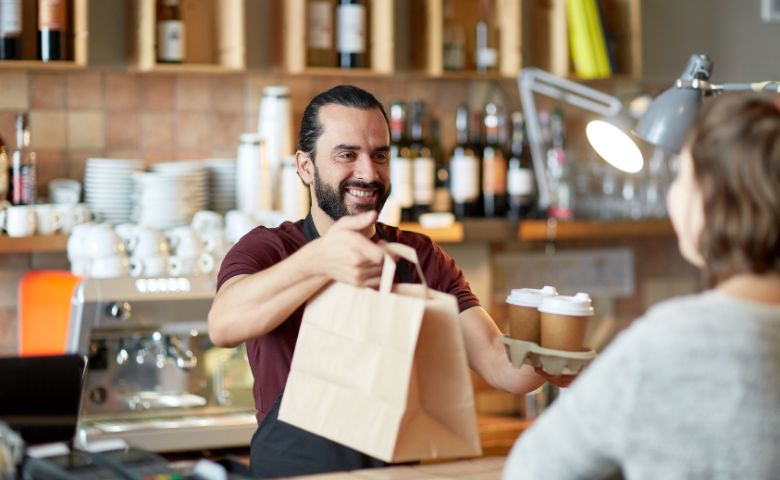
Take away is a model in which the customer picks up the order to go, instead of eating on site. It became popular during the COVID-19 pandemic, as it helped reduce the chances of contagion and was a way for restaurants to keep operating.
Now, many establishments keep offering this option to customers and others are creating business models based on this concept. Among the benefits are lower operating costs, revenue diversification and, of course, convenience for customers.
If you want to know more about how it works, what the advantages are and how to implement take away in your restaurant, keep reading this article!
What is take away and how does it work?
“Take away” is a concept applied in food businesses — such as restaurants, snack bars and food trucks —, in which the meal is prepared to go. In other words: the customer just picks up the order at the counter or another designated spot, and does not eat on site.
In Brazil, take away is practiced by 57% of food service operators, according to a survey conducted in 2023 by ANR (Associação Nacional de Restaurantes), Galunion (a specialized consultancy) and ABIA (Associação Brasileira da Indústria de Alimentos).
Some establishments offer this option as a way to diversify sales and also provide more convenience to customers.
When accessing the delivery app, for example, the person can select “Pick up the order on site” and just stop by to get it when it is ready. Another possibility is to provide totens de autoatendimento so that customers can place their orders and choose whether they want to eat on site or pick up to go.
In addition, with the popularization of this model and greater acceptance from consumers, more and more businesses that work exclusively this way are emerging.
The big advantage is that a take away restaurant can do without table service — which allows for a leaner structure and cuts operating costs.
What is the difference between take away, delivery and drive-thru?
These three models have some similarities, but they are not the same. The main characteristic they all share is that the customer does not eat the meal at the establishment.
Understand the differences between take away, delivery and drive-thru below:
Take away
It is the pickup service. In it, the customer places the order online (through the website, app or WhatsApp, for example) or in person and picks it up at the establishment's counter to eat somewhere else.
Delivery
Delivery is the delivery service. In it, the customer places the order online or by phone and receives it at whatever address they want.
Drive-thru
The most common model in fast food chains, in which the customer does not need to get out of their own car to order and pick up the order at the establishment.
What are the advantages of take away?
The take away model has several advantages, both for establishments and for customers. Check out some of them below!
Lean structure
A take away restaurant does not need to have a dining room with tables for customers to eat their meal. So its structure can be simpler: enough to take customers' orders, organize inventory and prepare the meals.
In addition, since there is no table service, there is no need to have equipment and utensils to serve the meals.
Reduction of operational costs
Another advantage of this model is the reduction in operating costs when compared to a full-service restaurant or even to a delivery operation.
There is no need to invest as much in physical structure, to have a large service team or to hire delivery drivers.
Expanding the customer base
In the case of restaurants that already work with full service, offering take away is a way to reach another consumer profile: the one looking for convenience and quick meals (but not necessarily fast food).
This way, your business can attract more people and expand the customer base — and, consequently, revenue.
More convenience for customers
Consumers look for convenience and, often, take away service is what best fits their routine. Instead of eating on site, many prefer to leave work and stop by the restaurant to pick up dinner for the family, for example.
It is an intermediate option between eating on site and ordering delivery. Therefore, a restaurant that offers this type of service is providing several consumption possibilities for customers.
In fact, this variety can help build customer loyalty. Since they can choose how they want to consume at different times, they come back more often.
Leia também: Service excellence: 11 tips for your restaurant
Tips for implementing take away in your restaurant
The take away model is simple to implement. The order and the payment are made at the establishment itself, and there is no need to worry about the delivery, as happens with delivery.
But some points are important and contribute to a better customer experience. Below, we list some tips for succeeding with this model!
Packaging
Being careful when packing orders is essential to avoid accidents (like spilling sauces) and meals with a disastrous presentation (nobody likes food all jumbled up, right?).
Invest in good packaging and take the opportunity to reinforce your brand, including your visual identity and messages for your customers. That way, they connect even more with your establishment.
Scheduling
Allow customers to schedule the time when they will pick up the order.
This is an extra convenience that can be a big differentiator, since the customer will not have to wait for the order to be prepared. But watch out: you need to honor what was agreed so as not to create dissatisfaction.
Physical space
Even though the structure of a take away restaurant is leaner, that does not mean it does not deserve attention. Customers are going to visit the establishment, so it is important to have an adequate space to receive them. You do not want to make a bad impression, right?
Order organization
Convenience and practicality are essential for a take away operation. Since they are just picking up orders to go, customers expect more speed so they do not have to keep waiting for a long time.
That is why you need to organize orders so they are prepared with maximum efficiency. Having a POS system integrated with the KDS is the best way to record and track the preparation of orders.
Extra tip: Self-service for take away
Self-service solutions can make the customer experience even better, since they will have the autonomy to place their own order and do not need to wait to be served.
A QR Code digital menu like EPOC GO lets the customer access the menu, place the order and pay using their own smartphone.
Another option is KIOSK, a self-service kiosk that can be available at the counter or another spot in the establishment so the customer can browse the menu, place the order and pay.
Both can be integrated with a KDS system with a pickup screen (with numbers), so that the production and delivery of orders is even faster.
If you want to know more about these and other EPOC solutions, Schedule a free demo right now!