Tablet for Restaurants: How to Choose and Use It

Very popular since the iPad first appeared, tablets have gained great importance in many segments – and in the world of food service it is no different. This device makes it possible to streamline service, cut costs and build customer loyalty.
So that you can take advantage of these benefits at your establishment, we have put together everything you need to know about how to use a tablet for restaurants!
How to use a tablet for restaurants
This device, as innovative as it is multifunctional, gives you a range of features and resources at your restaurant's disposal. Much more versatile and affordable than a computer, it is an effective and mobile solution.
A restaurant with a tablet can use it as a menu, tab, payment method, satisfaction survey and much more.
Below you will learn the main uses of a tablet for restaurants.
Online menu
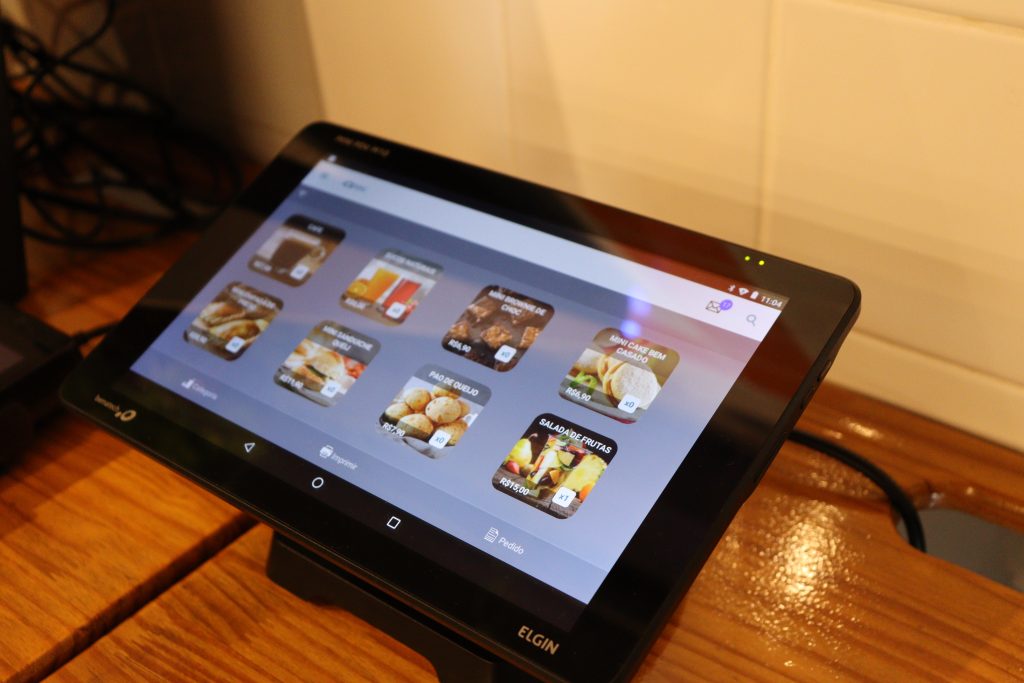
One of the most common uses is as a tablet for taking orders in a restaurant. Isso possibilita uma maneira mais autônoma e rápida de visualizar as opções do menu. Assim, traz mais modernidade e praticidade ao estabelecimento, além de otimizar a sua operação.
Whether as a tablet for the waiter or a device available at the table, with this device it is possible to view every item on the menu and place the order. Depois, ele é enviado automaticamente para a área de preparo e, após, recebido direto na mesa.
digital tab
The other most common use for this type of device – which can happen at the same time as the Online menu – is having a tablet for electronic tabs.
Similar to the previous use, this type of restaurant tablet system is focused on improving the customer's buying and payment experience.
Most of the time, the digital tab on a tablet can also incorporate the menu. That way, a customer can view the menu items, add them to the tab and send the order to be prepared.
In this case, the big difference is that the order record is available for virtual viewing, whether by the service staff or by the customers themselves.
In addition, a tablet for electronic tabs allows customers to pay on their own through the device via online transactions (with cards or Pix).
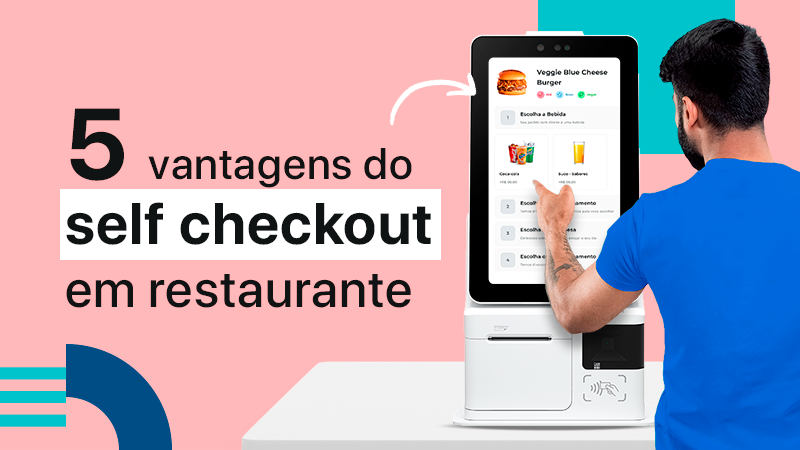
Self-Service Kiosk
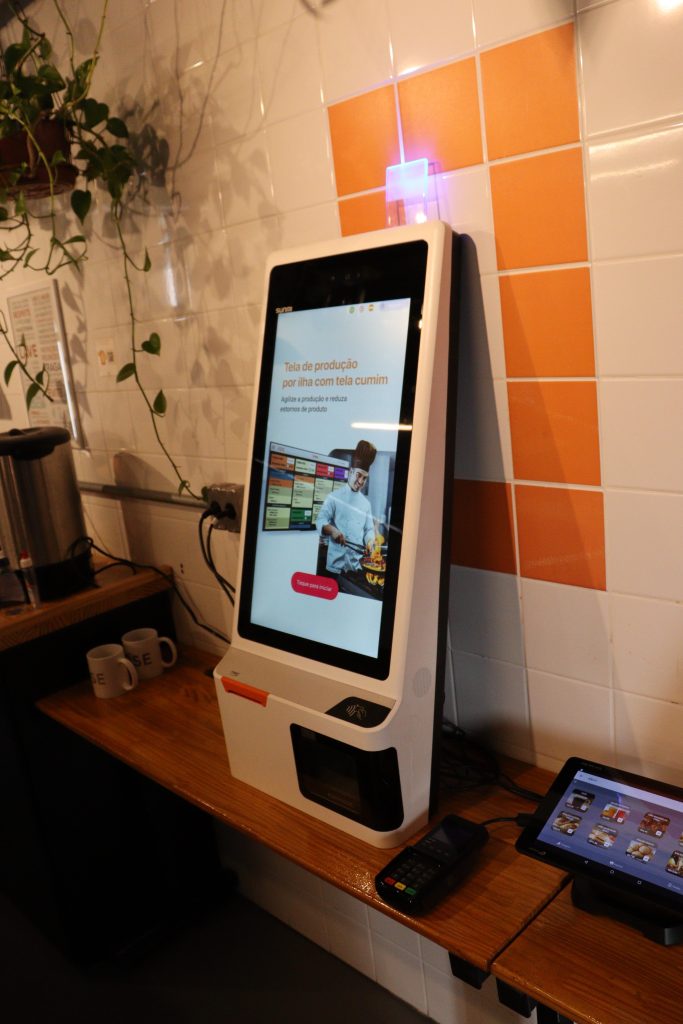
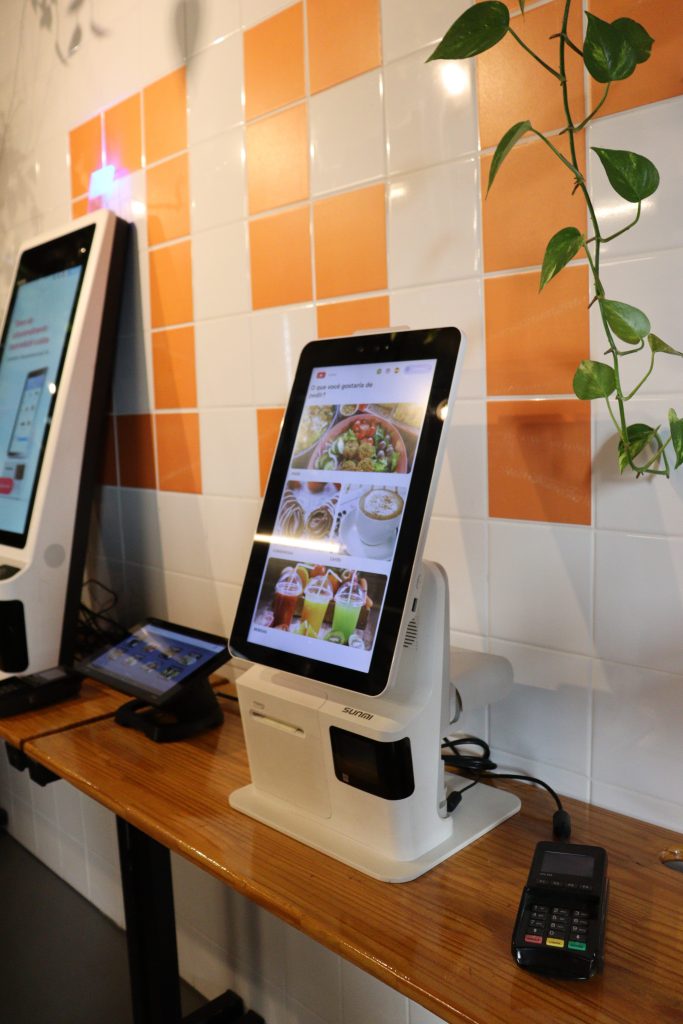
This type of use also tends to incorporate the tab and digital menu into a single device. In addition, a Self-Service Kiosk made with a tablet can also act as a mobile pos.
It is worth noting that, unlike the other uses of a tablet for restaurants, this one tends to be more fixed in nature. This can reduce the potential flexibility of service, but it tends to increase customers' speed and autonomy when ordering and paying.
Feedback kiosk
In addition, a kiosk can also be used in other ways in your restaurant. If you want to go further, you can use a tablet as a feedback kiosk.
On it, include questions and metrics that help collect information about your customers' experience.
You can encourage this feedback through promotions, cashback and other ways of offering a reward for your customers' opinions.
The important thing is to make collecting this data easy – through tablets for restaurants – and to take steps to implement the improvements and changes that come out of it.
What are the advantages of a restaurant with a tablet
After understanding how to use these devices at your establishment, it is time to learn all the benefits they can offer. As you have probably noticed, the main ones are speed and savings – but it does not stop there. Check it out!
Lower costs and higher profitability
A tablet for restaurants lets you cut operating costs by unifying tab, menu and POS in a single device.
That alone already represents savings on printing, computers, payment machines, printers and various supplies.
But beyond that, a restaurant with a tablet also manages to increase its profits. The device allows staff to optimize their activities and, in doing so, maximize sales.
That way, instead of constantly moving from the tables to the kitchen, reviewing orders or even handling waiting lines at the register, employees focus on improving the restaurant's processes (reducing errors and waste).
On top of that, they also serve more customers in less time. So it is possible to increase sales, ensure a good customer experience and, with that, make them come back again and again.
Faster service and production
Speaking of customer experience, a tablet also helps ensure that your consumers are happy and satisfied. It helps you find out what can be improved at your establishment.
First, with it your restaurant creates a more modern, automated and fast experience when ordering and paying. This makes orders arrive more quickly both in the prep area and at the customers' table (and never with errors).
The same happens at the moment of paying: whether at the table itself or at a self-service kiosk, it becomes much easier and faster – and it also increases table turnover.
In addition, a restaurant tablet can be used as a KDS display (Kitchen Display System) in the kitchen of your establishment. That way, your team can clearly and immediately see which orders need to be made in order of priority.
Another use is in the form of the pickup screen. It lets you tell your customers that their orders are ready right after they are prepared. This can happen at a counter or even at the table itself. The result of this technology is to offer with much more speed and convenience, improving your customers' experience.
Improving the customer experience
It is speed and autonomy that win customers over. The sum of these benefits creates an unforgettable experience and, with that, your customers keep coming back. After all, nobody likes staying in a restaurant where service is slow, orders arrive wrong and there are still huge lines when it is time to pay.
That is exactly the speed and autonomy you provide to customers when you use a tablet for restaurants. As you have already seen, this device can act as a menu, tab, POS and feedback kiosk.
So, the tablet improves the entire customer journey, from the moment they arrive until it is time to pay the bill – and, before leaving, giving feedback on what the experience at the restaurant was like.
With this data, you can keep improving your restaurant and enhancing the quality of service and operations to ensure customer satisfaction. All thanks to technology.
What to consider when buying tablets for restaurants
Perhaps one of the only difficulties when adopting a tablet for restaurants is finding the right device model that meets all the needs of your establishment.
In addition, another factor that gets in the way of this search is precisely the wide variety of tablets. The market offers a range of brands, specs, models and features that may help your restaurant – or not. It is up to you to understand all of this; and the good news is that you are not alone in this task.
Below we explain some of the main features that demand your attention when choosing a tablet for your establishment. It is important to point out that you should adapt each of these items according to how important each one is for your business. Check it out!
Compatibility
The first step when buying the tablet is to make sure your future device fits into your restaurant's daily routine.
In that sense, assess whether a given model and/or brand is familiar to your team, whether it can connect easily to other devices that you own (such as computers and printers).
Another point that deserves attention is the device's operating system. Although the iPad started the popularization of the tablet, Apple's model tends to have a higher cost and, on top of that, low compatibility with third-party software and solutions.
That is why the ideal is often to opt for an Android system, from Google. It is the most widely used on smartphones and tablets, and is highly compatible with many other platforms and tools.
That way, you ensure that all the devices will work together and avoid headaches from discovering, after the purchase, that a tablet is not compatible with some piece of equipment.
In addition, you can pair the tablet with a restaurant system that helps ensure this compatibility – learn more about that further on.
To understand this better, research each device you are thinking about buying and use online tools to compare the main technical specifications of each one.
Performance
The second aspect you need to take care of when purchasing tablets for restaurants is the device's performance. It may seem that this only takes into account a relationship between memory, processor, software and other aspects, but that is not quite how it works.
First, it is important to find out what performance means for your establishment. Por exemplo, você precisa de muito espaço de armazenamento para salvar diversos apps e arquivos, ou o melhor é contar com alto processamento e armazenamento pequeno, pois você usará poucos apps?
Is the goal to keep the device fixed at the table, or for it to be carried around by staff and/or customers? In the first case, the tablet can be heavier and bigger; in the second, it must be light and durable (after all, an accident or a drop can happen while moving around).
In other words: define the performance priorities for the tablets in your restaurant and then look for devices that fit those priorities.
In addition, it is healthy to establish which aspects are irrelevant for the restaurant. For example, camera quality may not be that important since it will only be used to scan QR Codes. The same goes for features like 5G connectivity, since the tablets (as a rule) will be connected via wifi.
Learn more: Why adopt QR Code for your restaurant?
Cost-benefit
This is a very important factor that can be decisive, especially depending on how you will use the tablets for restaurants. Taking performance, lifespan and compatibility into account, you finally need to assess the investment in the devices.
Consider how much you can invest and for how long the devices will be used. Also weigh the possible maintenance costs, the possibility of updates in the future and ease of use for the users/staff.
That way, you will find the ideal tablet for restaurants for your establishment – and one that fits your budget.
Do even more with a restaurant system with a tablet
It is possible to increase the benefits of this type of device even further to ensure they work efficiently, securely and autonomously. To do that, just use a restaurant system with a tablet, such as EPOC.
With it, you ensure that the tablets connect to the POS (or act as one), to inventory and to the ERP without any problems. In addition, EPOC lets you use the devices as a menu, tab, self-service kiosk, KDS or pickup screen in a fully integrated and easy way.
To find out how these features can help your restaurant increase sales and build customer loyalty, see a free demo of EPOC and talk to one of our specialists with no obligation.