Tasting menu: how to create yours

If you are looking for a way to attract new customers, show off the best creations from your chef and deliver a standout experience, then creating a tasting menu is without a doubt an excellent idea.
This type of menu came out of renowned fine dining restaurants. The idea is to serve a sequence of dishes in small portions.
Despite its refined origins, this is a trend that has been gaining ground in every type of restaurant — and you can adopt it too! Keep reading to understand what it is, learn how to create one and see an example of a tasting menu. Follow along!
What is a tasting menu?
A tasting menu is a special menu designed so the customer can try several of a restaurant's dishes in smaller portions.
In general, it is made up of starters, main courses and desserts, plus drinks for pairing.
And when we say “try”, it is not only in the sense of “tasting”, but also of having a the dining experience standout experience.
The idea is to offer a complete meal that showcases the concept of the restaurant, the technique and the creativity of the chef and their team. That is why it is also known as a “sample menu” or even a “trust menu”.
How does it work?
The dishes are served in stages, also called “courses”, often following an order designed to stimulate the palate and highlight different flavors and textures.
The average number of stages ranges from 7 to 10, but there are restaurants that go up to 20. Because of that, the service usually takes a few hours to finish — so it costs more. But that does not make it any less worthwhile, as we will see below.
Leia também: What is menu engineering?
Why adopt it in your restaurant?
Now that you know what a tasting menu is, you need to figure out whether adopting this trend makes sense for your business.
As we saw at the beginning of this article, it is usually associated with fine dining restaurants, but that has been changing and more casual establishments can benefit too. Some advantages of the tasting menu are:
Attract and retain customers
One of the main advantages is, without a doubt, attracting new customers to your restaurant.
People are drawn to standout experiences and also to the chance to try several dishes in a single meal. That is why having a tasting menu is a great draw.
And more: if the service is done well and the experience wins over your customers' hearts, chances are they will want to come back another time to have the dish they liked most again.
Also check out: Loyalty program for restaurants: how does it work?
Highlight the best dishes
On a traditional menu, it can happen that excellent dishes get little visibility and end up not getting the attention they deserve.
The tasting menu helps showcase the very best of your restaurant, reinforce your brand's concept, and earn greater recognition.
Serving more creative presentations
Another advantage is that, since the portions are smaller, the chef and their team can be more creative and daring in how they plate the dishes, impressing customers at every course and making the experience even more amazing.
On top of that, there's a good chance customers will take that photo for social media, tagging your restaurant and, in doing so, helping to promote your business.
Testing new dishes
This type of menu is also a great opportunity to test new dishes before officially adding them to the menu. The chef can test recipes and presentations and gather feedback from customers — who knows, maybe a new bestseller will come out of it?
Delivering an exclusive experience
People love exclusivity, and the tasting menu delivers exactly that. The best dishes, impeccably plated, paired with the perfect drink, served across many courses with outstanding service.
It's the chance to prove your restaurant's excellence and make customers feel special.
Leia também: Gastrobar: what is it and how does it work?
8 steps to build a flawless tasting menu
The menu should be created by the chef together with the rest of the team. Planning is essential not only to guarantee an excellent dining experience, but also to make sure it brings a good return for the restaurant.
Check out the step-by-step below and understand how to create a tasting menu.
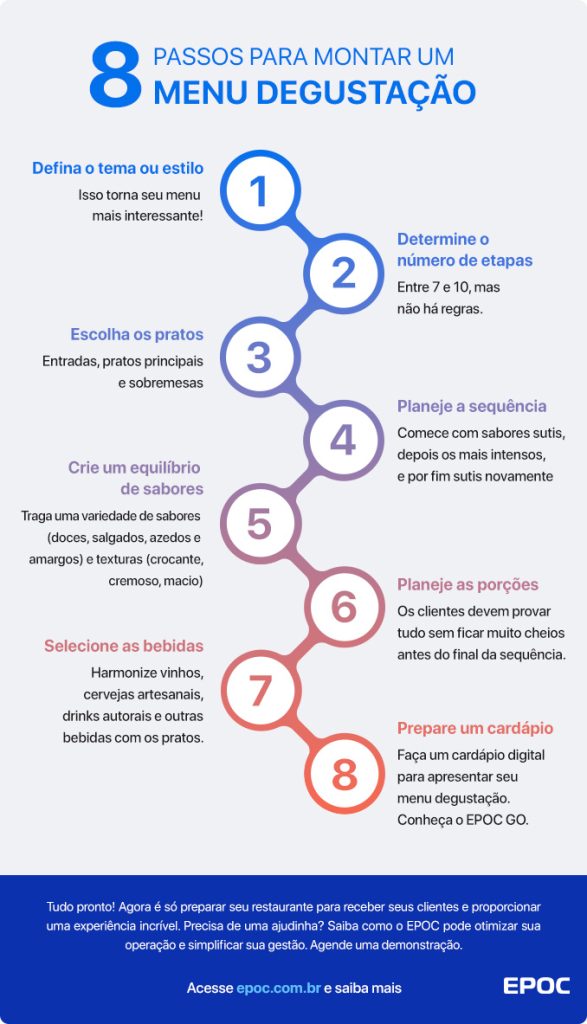
Step 1: Define the theme or style
The best tasting menus tell a story. Defining a theme or a style helps make the experience more appealing and interesting, and it also reinforces your restaurant's concept.
Step 2: Determine the number of courses
The number of courses in a tasting menu ranges from 7 to 10, but there's no rule. So it's up to the restaurant to decide, considering the concept, the feasibility, the costs, and also its service capacity.
Step 3: Choose the dishes
This is the most creative part! The chef and their team should define the dishes according to the theme and the number of courses.
Here, it's worth bringing in both the menu's “stars” and exclusive dishes. What matters most is having a variety of dishes that complement each other.
Step 4: Plan the sequence
The order in which the dishes are served is extremely important to the tasting experience. You need to guide the palate.
In general, the flavors of the appetizers are lighter and subtler, then move on to more complex and intense dishes, and end with desserts or lighter bites once again.
Step 5: Create a balance of flavors
Beyond a specific order, you also need to pay attention to the variety of flavors. The sensory experience will be richer if there's a balance among flavors (sweet, salty, sour, and bitter) and textures (crunchy, creamy, soft).
Step 6: Plan the portions
The portions should be smaller than in a traditional meal. To get them right, keep in mind that they need to be small enough for customers to taste everything without feeling too full by the end of the sequence. In other words: take into account the number of dishes and the length of the service.
Step 7: Select the drinks
Select drink options that pair with the dishes offered: wines, craft beers, signature cocktails, and non-alcoholic drinks as well.
Step 8: Prepare a menu
To finish, create a menu. It can be a traditional printed one or a digital menu. Inclua a lista de pratos e bebidas, com descrições breves e atraentes, destacando os principais ingredientes e as técnicas utilizadas no preparo.
Tasting menu ideas to inspire you
For the tasting menu to become a true dining experience, you need to go beyond the traditional “appetizers – main course – desserts”. Below, see some ideas that will help you develop a concept and impress your customers
Give it a name
Believe it: giving your menu a name can help reinforce your restaurant's concept and make the experience more interesting.
A good example is the tasting menu at “A Casa do Porco”, by chefs Janaína and Jefferson Rueda. They always come up with a name that expresses the idea behind the menu. Such as: “Somos Todos de Carne e Osso”, “Da Roça para o Centro” and “Nosso sangue é latino”.
Tell a story
Share what inspired the dishes, where the ingredients come from, the preparation technique. Stories create connection and stir emotions, and that makes the experience more complete and interesting, going far beyond the food.
Chef Helena Rizzo, from the restaurant Maní, explains in an interview how she created, in partnership with Willem Vandeven, a tasting menu born from a reflection: “What is Brazilian food? How do we put a little of all of that into the pot and make something from here, that has a face from here, that has a Brazilian expression?”
Create seasonal menus
It's also good practice to create seasonal menus that follow the time of year. That way you can take advantage of the best ingredients of the season, vary the options, create new dishes, and always have something new for your customers.
Create a “celebration menu”
A special tasting menu is an excellent way to celebrate and attract customers. It can mark an anniversary, a holiday, or even a theme. For example: a Mexican restaurant can create a menu especially for “5 de mayo”.
Offer pairings
Choose drinks that go well with the dishes. Offering a tasting menu with drink pairings sets you apart, and it can also help increase your revenue.
Also check out: Fine Dining Menu: How to Stand Out?
Tasting menu example para restaurantes
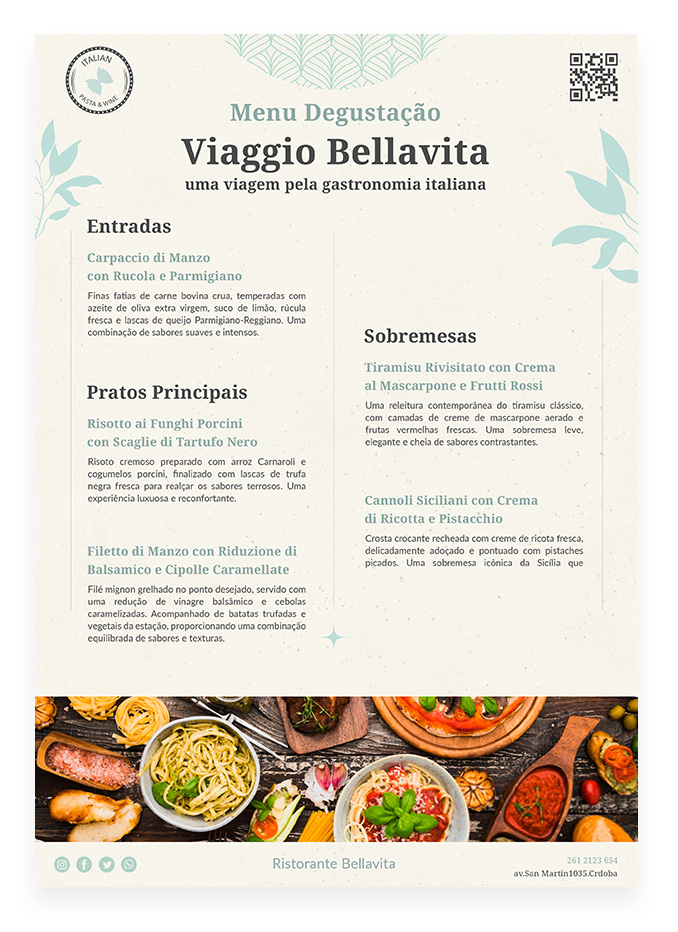
And to illustrate everything we've covered so far, we created a tasting menu example to help you create your own menu. It's important that it looks attractive and that the information is clear and well organized.
Divide the menu into Appetizers, Main Courses, and Desserts, and include a description of each dish. See how it turned out in our example:
Is it worth it for your restaurant?
So far, we've talked a lot about dishes, pairings, concept, experience… But the tasting menu goes beyond all of that and, for this service to be worth offering in your restaurant, you need to take some precautions.
The first one has to do with pricing. Como é composto de muitas etapas e pratos, pode ficar caro demais, espantar os clientes e até gerar prejuízos para o restaurante.
So, factoring in the production costs of the dishes included is essential. Use the Recipe cards, put everything down on paper, run the numbers, and plan a menu that's financially viable.
Another essential precaution is the variety of ingredients. There's no point in creating a special menu full of different ingredients only to end up generating waste. So be strategic, understand the supplies in your inventory, and think about how you can use them in your menu.
Finally, invest in marketing! Use your social media to show what the experience is like, post Photos of the dishes, invite digital influencers to your restaurant. Promotion is the key to success.
Count on EPOC to optimize the management of your business
EPOC is a management system for restaurants, bars, and nightclubs. We offer POS, back office, digital menu, and self-service solutions, and much more!
If you need to optimize your operation and make your management easier, we can help. Agende uma conversa and find out how!
Frequently Asked Questions
What is a tasting menu?
The tasting menu is a special menu designed so customers can try several of a restaurant's dishes in smaller portions. It generally consists of appetizers, main courses, and desserts, plus drinks for pairing.What is a tasting menu with pairings?
The tasting menu with pairings includes drinks that complement the dishes. These can be, for example, wines, craft beers, signature cocktails, and non-alcoholic drinks.How does a tasting menu work?
The tasting menu includes appetizers, main courses, and desserts. The dishes are served in stages, also called “courses”. The average number of courses ranges from 7 to 10, but some restaurants go as high as 20.How do you build a tasting menu?
The tasting menu is a complete meal that showcases the restaurant's concept and the technique and creativity of the chef and their team. The step-by-step to build one is:Step 1: Define the theme or style
Step 2: Determine the number of courses
Step 3: Choose the dishes
Step 4: Plan the sequence
Step 5: Create a balance of flavors
Step 6: Plan the portions
Step 7: Select the drinks
Step 8: Prepare a menu